
The World’s Fair of 1893 was being held in Chicago. It was going to be unlike anything anyone had ever seen before.
More than 160 000 electric lightbulbs were set to illuminate the fairgrounds making it the largest demonstration of electricity ever. (1)
But electricity was still relatively new, and insurers were raising alarms about the risks of fires caused by this untested new technology. They had been paying out for enormous fire losses caused the unproven and unregulated electrical industry.
Not wanting to be on the wrong end financially of this World Fair, insurance underwriters sent a young electrical engineer, William Henry Merrill Jr. to inspect the electrical installation and assess the risks. But instead of just inspecting the installation, he went an important step further.
He began scientifically testing the electrical equipment independent of the manufacturers claims of safety.
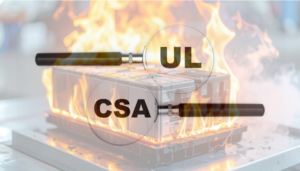
The Fair was a success and concluded without a fire, demonstrating to the world that electricity could be used safely – but only with proper inspection, design, and testing. His work convinced Merrill that independent testing of all products should become permanent. In 1894 he founded what is now known as UL (Underwriters Laboratories).
Innovation continued and companies continued to manufacture. Some making claims that their products were fireproof. Then in 1903 the Iroquois Theatre in Chicago caught fire and killed more than 600. These untested claims exposed the danger of products that hadn’t been independently tested. Merrill was more convinced than ever that everyone needed a simple way to identify the safety of a product. A way to know that it had been tested. And that was the inspiration behind the UL listing mark, or sticker, that we see today.
At this time, Canada was facing many of the same challenges. Industry was growing, railways were being built and cities were expanding across Canada. The lack of standardization between provinces made it difficult to sell products across the country. The lack of regulation meant that things weren’t necessarily as safe as claimed.
In 1919, the Canadian Engineering Standards Association (later becoming the Canadian Standards Association, and now simply the CSA group) (2) was formed with a mission beyond just electrical standards. The CSA worked to create standards across manufacturing that all Canadian governments could trust – one national standard – to unify Canadian manufacturing.
These little logos marks on our appliances and throughout our homes and buildings are easy to take for granted when in fact they represent:
▪ Independent testing
▪ Repeatable manufacturing processes
▪ Ongoing manufacturing audits
▪ Compliance with recognized safety standards
For engineers, these certifications add clarity and reduce uncertainty.
For manufacturers, they open markets.
For customers, they build trust.
The potential for fire in those first wiring systems of the 1890’s isn’t the reason UL and CSA exist today.
They exist today because someone realized that fire could be prevented.
Someone asked William Henry Merrill, “How do we know if this is safe?” and he used his foresight: How can we prevent disasters before they happen?”
Now, all these years later, these certifications help keep us safely fire-free and up with innovation.